

Smart Port Market to Reach USD 15.97 Billion by 2032, Growing at 24.7% CAGR
Smart Port Market Size
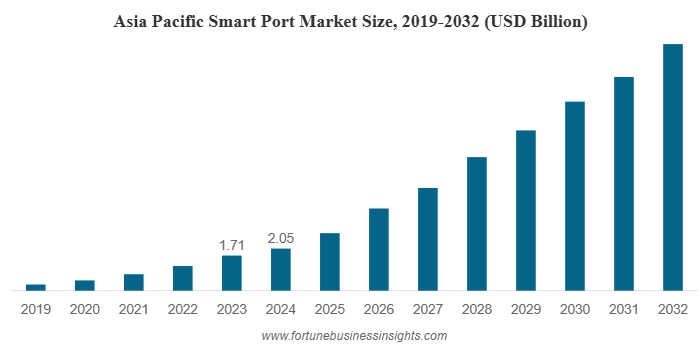
Asia Pacific dominated global market with a share of 72.7% in 2024.
Rising Need for Immediate Data and Transparency in Supply Chains to Drive Market Trends”
PUNE, MAHARASHTRA, INDIA, February 9, 2026 /EINPresswire.com/ -- The global smart port market size represents a dynamic transformation in maritime logistics, driven by increasing automation and digitalization needs. According to Fortune Business Insights, the market achieved a valuation of USD 2.82 billion in 2024 and demonstrates substantial growth potential, projected to reach USD 15.97 billion by 2032, representing a robust compound annual growth rate of 24.7% throughout the forecast period from 2025 to 2032.— Fortune Business Insights
Smart ports incorporate cutting-edge technologies including Internet of Things sensors, artificial intelligence analytics, blockchain platforms, and automated equipment to enhance operational efficiency and sustainability. These facilities serve as vital instruments for global trade hubs, addressing traditional challenges such as congestion, delays, operational inefficiencies, and environmental impacts through advanced digital solutions.
Get a Free Sample PDF- https://www.fortunebusinessinsights.com/enquiry/request-sample-pdf/smart-ports-market-112364
Regional Market Dynamics
Asia Pacific emerges as the dominant force in the smart port landscape, commanding an impressive 72.7% market share in 2024. This regional leadership stems from several converging factors: the area serves as a global manufacturing powerhouse, hosts major trade routes, and benefits from substantial government investments in port modernization initiatives. Nations including China, Singapore, and South Korea have committed significant resources toward building intelligent infrastructure and implementing automation technologies.
The region's maritime dominance is further evidenced by data indicating Asia Pacific represented 54% of global maritime trade in 2021. This concentration creates fertile ground for smart port development, as increasing cargo volumes necessitate enhanced operational capabilities and efficiency improvements.
Technological Foundations
The evolution toward intelligent port operations relies on several technological pillars. Internet of Things technology leads market adoption, enabling comprehensive real-time data collection and analysis through sensor networks deployed across port facilities. Process automation follows closely, accounting for significant market share as ports seek to streamline cargo handling and reduce manual intervention.
Artificial intelligence and machine learning applications provide predictive maintenance capabilities, optimize resource allocation, and enhance decision-making processes. Blockchain technology contributes to secure, transparent data sharing among port stakeholders, facilitating improved communication and collaboration. These integrated solutions collectively enable ports to achieve operational excellence while reducing environmental footprints.
Market Drivers
International maritime commerce serves as a fundamental growth catalyst. With approximately 80% of global trade volume transported by sea according to UNCTAD data, efficient port operations become increasingly critical. Maritime trade volumes expanded by 4.1% in 2021 and are projected to maintain steady annual growth exceeding 2.4% through 2026.
The demand for operational efficiency drives adoption as port operators seek solutions for streamlined cargo handling, optimized container tracking, and automated operations. Real-time data visibility and supply chain transparency have become essential requirements as global trade networks grow more complex. Smart ports deliver these capabilities while simultaneously reducing operational costs and improving turnaround times.
Government initiatives provide substantial momentum for market expansion. Infrastructure development programs worldwide allocate billions toward port modernization projects. For instance, the United States Department of Transportation announced USD 292.7 billion in port infrastructure investments, while India's development plans include USD 82 billion designated for port initiatives by 2035.
Operational Categories
Port classification by throughput capacity reveals distinct market segments. Extensively busy ports handling volumes exceeding 18 billion TEU constitute the largest segment, having invested heavily in comprehensive smart infrastructure encompassing terminal automation, cargo management systems, port community platforms, and safety solutions. These major facilities in locations such as China, Singapore, and South Korea serve as crucial trade operation hubs.
Moderately busy ports processing between 5 and 18 billion TEU represent the fastest-growing segment, as these facilities modernize to enhance competitiveness and operational efficiency. This growth category demonstrates how technological advancement extends beyond mega-ports to encompass diverse facility scales.
Component Analysis
Smart port infrastructure forms the largest market element, comprising automated docking systems, shore power capabilities, automated gate systems, and advanced energy solutions. These foundational components enable the physical transformation of port facilities toward intelligent operations.
Traffic Management Systems demonstrate the fastest growth trajectory among elements, addressing the complexities of modern maritime logistics through optimized vessel movements, berth allocation, and cargo flow coordination. These systems become increasingly vital as ship sizes expand and traffic volumes intensify.
Terminal automation and cargo handling solutions enhance productivity through autonomous cranes, self-driving trucks, and intelligent sorting systems. Port Community Systems facilitate information sharing among stakeholders, while smart safety and security measures protect both physical assets and digital infrastructure.
Market Challenges
Implementation barriers include substantial capital requirements for technology integration and infrastructure upgrades. Smaller ports and developing regions may find these initial investments prohibitive, potentially limiting adoption rates in certain areas. The extended return on investment timeline additionally creates hesitation among some stakeholders.
Cybersecurity concerns present ongoing challenges as increased digitalization creates new vulnerability points. Historical incidents demonstrate potential disruptions, making robust security measures essential. Data management complexity also requires careful attention as ports handle vast information volumes across interconnected systems.
Integration of new technologies with existing infrastructure can prove complicated and time-consuming, requiring careful planning and phased implementation approaches to minimize operational disruptions during transition periods.
Speak To Analyst- https://www.fortunebusinessinsights.com/enquiry/speak-to-analyst/smart-ports-market-112364
Competitive Landscape
The market features a somewhat fragmented structure with multiple significant players offering diverse solutions. Leading companies including Intel Corporation, ABB Limited, Huawei Technologies, IBM Corporation, and KONGSBERG provide comprehensive service portfolios spanning automation, analytics, and infrastructure solutions. These industry leaders leverage extensive regional presence and accumulated expertise to maintain competitive positions.
Market participants emphasize continuous innovation, integrating emerging technologies such as artificial intelligence and advanced IoT capabilities into their offerings. Strategic partnerships and collaborative projects between technology providers and port authorities drive implementation of large-scale digital transformation initiatives across major maritime hubs globally.
Ashwin Arora
Fortune Business Insights™ Pvt. Ltd.
+1 833-909-2966
sales@fortunebusinessinsights.com
Legal Disclaimer:
EIN Presswire provides this news content "as is" without warranty of any kind. We do not accept any responsibility or liability for the accuracy, content, images, videos, licenses, completeness, legality, or reliability of the information contained in this article. If you have any complaints or copyright issues related to this article, kindly contact the author above.
