

Smart Electric Meter Market Projected to Reach USD 55.05 Billion, at a 8.3% CAGR During the Forecast 2026 To 2035
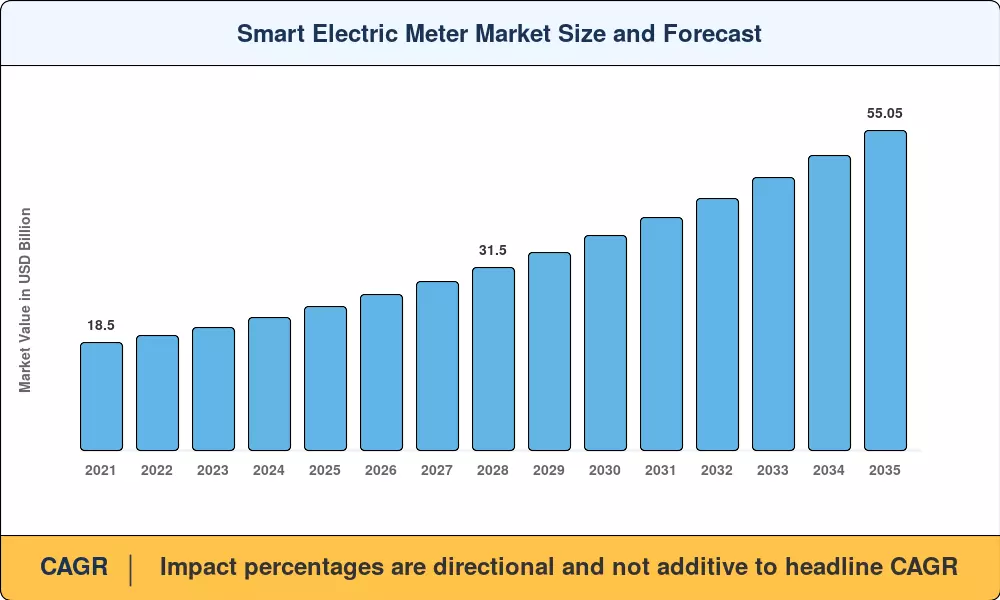
Smart Electric Meter Market Summary
Several growth drivers are propelling the Smart Electric Meter market forward at a robust 8.3% CAGR.
NY, CA, UNITED STATES, June 17, 2026 /EINPresswire.com/ -- The global Smart Electric Meter Market stood at USD 24.80 billion in 2025, with the forecast trajectory projecting a rise from USD 26.86 billion in 2026 to approximately USD 55.05 billion by 2035, reflecting a compound annual growth rate of 8.3% across the 2026–2035 window.Smart Electric Meter Market Overview
The Smart Electric Meters Market encompasses advanced digital devices that record electrical energy consumption in real-time and communicate this data to utility providers for monitoring, billing, and grid management purposes. Unlike traditional electromechanical meters, smart meters enable two-way communication between consumers and utilities, facilitating remote reading, real-time usage analytics, time-of-use pricing, outage detection, and integration with distributed energy resources (DERs) such as rooftop solar and electric vehicle chargers. Smart meters are a foundational component of Advanced Metering Infrastructure (AMI), which includes the meter itself, communication networks, and data management systems.
Several growth drivers are propelling the Smart Electric Meter market forward at a robust 8.3% CAGR. Government mandates and regulatory frameworks worldwide are accelerating smart meter rollouts as part of broader grid modernization and energy efficiency agendas. The European Union's Clean Energy Package required 80% of electricity consumers in member states to have smart meters installed by 2020, while India's Revamped Distribution Sector Scheme (RDSS) targets 250 million smart meter installations. Rising global electricity demand—which grew by 4.3% in 2024 according to the International Energy Agency—necessitates more sophisticated consumption monitoring and load management capabilities. The integration of renewable energy sources and the proliferation of DERs require smart meters capable of bidirectional power flow measurement and net metering functionality.
Key industry trends include the integration of AI and big data analytics for predictive maintenance, load forecasting, and fraud detection. The deployment of 5G-enabled smart meters is enhancing data transmission speeds and enabling near-instantaneous two-way communication. Cloud-based meter data management systems are replacing on-premise solutions, offering scalable storage and advanced analytics capabilities. Edge computing is being embedded in smart meters to process data locally, reducing latency and dependence on central servers. Cybersecurity has emerged as a top priority, with utilities investing in secure communication protocols and encryption technologies to protect critical infrastructure.
Policy and regulatory influence is a primary market driver. The U.S. Department of Energy and electricity industry have jointly invested approximately USD 8 billion in 99 cost-shared smart grid projects under the Smart Grid Investment Grant (SGIG) program, contributing to approximately 119 million AMI installations—about 72% of all U.S. electric meter installations. The EU's Energy Efficiency Directive and national-level mandates continue to drive deployment across member states. India's RDSS scheme mandates smart meter rollout through public-private partnerships on a total expenditure (TOTEX) model.
Demand outlook is strongly positive, with the market projected to more than double over the forecast period. Asia-Pacific dominates the global market, holding a significant share of over 40.9% in 2025, driven by massive deployments in China and India. North America is expected to be the fastest-growing region in the forecast period, supported by ongoing grid modernization investments and federal incentives.
Get Free Sample Report for Detailed Market Insights:
https://www.marketresearchfuture.com/sample_request/11463
Smart Electric Meter Market Segmentation
The Smart Electric Meter Market is segmented by type, phase, communication technology, end user, and region.
By Type:
Advanced Metering Infrastructure (AMI): Integrated system enabling two-way communication between utilities and end-users; real-time data collection, remote meter management, and dynamic pricing capabilities. Expected to witness higher growth over the forecast period.
Automatic Meter Reading (AMR): One-way communication systems; declining share as utilities upgrade to AMI.
By Phase:
Single Phase Meters: Used in residential and small commercial applications.
Three Phase Meters: Used in industrial and large commercial applications with higher power requirements.
By Communication Technology:
Power Line Communication (PLC): Utilizes existing electrical wiring for data transmission.
Radio Frequency (RF): Wireless communication for neighborhood-level networks.
Cellular: Offers broad coverage and simpler manageability; increasingly utilizing 4G/LTE and emerging 5G networks.
By End User:
Residential: Largest and fastest-growing segment; driven by consumer demand for real-time consumption data and time-of-use pricing transparency.
Commercial: Offices, retail establishments, and commercial buildings.
Industrial: Manufacturing facilities, heavy industry, and large energy consumers.
Utility: Power generation and distribution companies.
By Region:
North America, Europe, Asia-Pacific, Middle East & Africa, Latin America.
You can buy this market report at:
https://www.marketresearchfuture.com/checkout?currency=one_user-USD&report_id=11463
Smart Electric Meter Market Regional Analysis
Asia-Pacific: The largest and fastest-growing regional market, holding over 40.9% of the global market share in 2025. China accounts for nearly half of the global market, driven by the State Grid Corporation's massive annual deployments and the national smart grid project. India is the fastest-growing major market, with the RDSS scheme targeting 250 million smart meters by 2025; as of December 2022, 222 million smart meters were sanctioned with 7.9 million already installed. India's robust economy, rising electricity consumption, and government initiatives are key growth drivers. Japan has nearly completed its nationwide smart meter rollout, driven by electricity market liberalization and disaster resilience priorities. South Korea, Australia, and Southeast Asian nations are also expanding deployments.
North America: The United States accounts for over 93.9% of the North American market. Approximately 119 million AMI installations were in place as of 2022, representing about 72% of all U.S. electric meter installations. Federal and state-level initiatives, including DOE's Smart Grid Investment Grant and the Inflation Reduction Act, continue to support adoption. California and Texas lead in smart meter deployment, particularly for supporting distributed energy resources and renewable integration. Canada follows with active deployments across provinces.
Europe: Stringent regulations and aggressive energy efficiency goals drive the market. Sweden achieved 100% smart meter coverage as early as 2003, followed by Finland (100%), Spain (first EU country to reach 100% coverage), Estonia (98%), and Denmark (approximately 80%). Germany initially delayed but approved a draft law to begin nationwide mandatory rollout, with legally enforceable timelines to reach 100% coverage by 2030. Utilities like Enel and E.ON have led large-scale deployment projects, often with government funding. The EU's Clean Energy Package mandates smart metering as essential infrastructure for energy efficiency and grid management.
Middle East & Africa and Latin America: These regions represent emerging markets with significant growth potential. The UAE, Saudi Arabia, and South Africa are progressing with smart grid modernization programs. Brazil and Mexico lead Latin American adoption, supported by government initiatives and utility investments in grid modernization.
Competitive Landscape / Key Players
The Smart Electric Meter Market is moderately consolidated, with established metering manufacturers, technology providers, and system integrators competing across global and regional markets.
Key companies active in the market include:
Landis+Gyr Group AG (Switzerland/UK): Global leader in smart metering and grid management solutions; significant presence across North America, Europe, and Asia-Pacific.
Itron, Inc. (US): Major provider of AMI systems, smart meters, and metering data management; strong presence in North America and international markets.
Schneider Electric SE (France): Comprehensive energy management and automation solutions; active in smart metering across commercial, industrial, and utility segments.
Siemens AG (Germany): Grid modernization and smart infrastructure solutions; smart metering and meter data management platforms.
Honeywell International, Inc. (US): Smart metering and energy management solutions; presence across residential, commercial, and industrial applications.
Kamstrup A/S (Denmark): Leading European smart metering manufacturer; strong in Nordic and European markets.
Aclara Technologies LLC (US): Smart infrastructure solutions for utilities; AMI systems and communication networks.
Wasion Holdings Limited (China): Major Chinese smart metering manufacturer; strong domestic and export presence.
ABB Ltd. (Switzerland): Grid automation and smart metering solutions.
Sagemcom Broadband SAS (France): Smart metering and communication solutions; strong in European and global markets.
Strategic developments include acquisitions (Kaynes Technologies acquired Iskraemeco India in September 2024 to strengthen product portfolio and global market presence), product innovations (Oakter launched OAKMETER in May 2024 with IoT, real-time analytics, and 4G connectivity), and partnerships between telecom providers and utility companies for smart meter connectivity (Bharti Airtel partnered with IntelliSmart to connect 20 million smart meters with IoT technology).
Latest Industry News & Developments
India's RDSS Program Accelerates Smart Meter Deployment (Ongoing): The Revamped Distribution Sector Scheme mandates smart meter rollout through public-private partnerships on a TOTEX (total expenditure) model to support state distribution companies (DISCOMS) and avoid post-implementation operational issues. The program targets 250 million smart meters by 2025, with significant progress reported.
Germany Mandates Nationwide Smart Meter Rollout (2025): Following years of delayed implementation, the German government approved legislation requiring mandatory smart meter rollout with legally enforceable timelines to achieve 100% coverage by 2030. This represents a significant market opportunity for metering manufacturers and system integrators.
GE Vernova Announces GridOS Data Fabric (February 2024): The company launched GridOS Data Fabric, a solution tailored to assist utilities in managing smart grids and leveraging smart meter data for grid optimization and operational efficiency.
Market Challenges & Opportunities
Key Restraints: High upfront investment costs—including hardware, communication networks, and backend systems—remain a barrier for many utilities, particularly in developing regions. Cybersecurity threats have emerged as a top concern; smart meters are critical IoT nodes exposed to potential breaches that could compromise grid stability or leak sensitive consumer data. Integration with legacy grid infrastructure and outdated IT systems presents significant technical complexity. Tariffs on imported semiconductors, communication modules, and electronic assemblies are increasing system deployment costs and delaying rollout schedules in some regions. Consumer data privacy concerns and resistance to mandatory rollouts in some European markets represent additional challenges.
Emerging Opportunities: Prepaid and pay-as-you-go smart meter models are gaining traction in emerging markets, enabling consumers to manage energy budgets effectively while helping utilities reduce revenue losses. The integration of smart meters with smart home systems and home energy management platforms (HEMS) is creating new consumer engagement opportunities. AI and big data analytics for load forecasting, predictive maintenance, and fraud detection represent significant value-added service opportunities. Supporting distributed energy resources—including electric vehicles, solar panels, and energy storage—through bidirectional metering and net metering capabilities is a critical growth driver.
Future Potential: The smart electric meter market is positioned for sustained growth, with the market projected to more than double from 2025 to 2035. The transition from capital-intensive procurement to outcome-based contracting is encouraging more integrated solutions combining hardware, software, and managed services. Interoperability and modularity in product design will enable utilities to integrate new technologies without replacing entire systems. As tariffs and trade policies evolve, regional manufacturing of meter components and diversification of communication module suppliers will strengthen long-term supply chain resilience.
To explore more market insights, visit us at:
https://www.marketresearchfuture.com/reports/smart-electric-meter-market-11463
Final Market Summary
The Smart Electric Meter Market is projected to grow from USD 26.86 billion in 2026 to approximately USD 55.05 billion by 2035 at a robust CAGR of 8.3%. This expansion is driven by government mandates for grid modernization, rising global electricity demand, increasing renewable energy integration, and the need for real-time consumption monitoring and dynamic pricing. Asia-Pacific—led by China and India—dominates the market, while North America and Europe represent mature but growing markets with significant replacement and upgrade cycles.
Key players including Landis+Gyr, Itron, Schneider Electric, and Siemens are competing through innovation in AMI, AI-driven analytics, and secure communication technologies. Challenges including cybersecurity threats, high upfront costs, and integration complexity persist but are being addressed through technological innovation and public-private partnerships. The long-term outlook remains positive as smart meters transition from simple measurement devices to essential infrastructure platforms for the digital, decarbonized energy grid of the future.
More Related Reports from MRFR Library:
https://www.marketresearchfuture.com/reports/smart-meters-market-4569
https://www.marketresearchfuture.com/reports/coriolis-meters-market-10882
https://www.marketresearchfuture.com/reports/manometers-market-23463
https://www.marketresearchfuture.com/reports/benchtop-capacitance-meters-market-27046
https://www.marketresearchfuture.com/reports/air-fuel-ratio-meters-market-38260
Larry Wilson
WantStats Research And Media Pvt. Ltd.
+1 855-661-4441
email us here
Visit us on social media:
LinkedIn
Facebook
YouTube
X
Legal Disclaimer:
EIN Presswire provides this news content "as is" without warranty of any kind. We do not accept any responsibility or liability for the accuracy, content, images, videos, licenses, completeness, legality, or reliability of the information contained in this article. If you have any complaints or copyright issues related to this article, kindly contact the author above.
